


- US - English
- China - 简体中文
- India - English
- Japan - 日本語
- Malaysia - English
- Singapore - English
- Taiwan – 繁體中文

As AI agents become long lived and concurrent, memory capacity, not just compute, has emerged as the deciding factor in real world AI workstation performance. At Dell Technologies World (DTW) in Las Vegas, Micron showcased a side by side demo that highlights a key shift in personal AI computing: AI is increasingly running locally on AI workstations, where people work continuously with agents that generate images, interpret intent and iterate in real time. In this setting, performance is defined less by peak specifications and more by execution quality, whether a system can maintain fluid execution or exhibit diminishing responsiveness over extended interaction cycles as user prompts and iterations accumulate.
AI workstations as a bridge to practical edge AI
Devices like the Dell Pro Max–class AI workstations are an important milestone on the road to AI at the edge, because they shift powerful AI capability from being primarily cloud-dependent to being available locally, right where work happens. AI workstations are purpose-built to run advanced AI workloads locally, supporting long lived, concurrent AI agents that preserve context and execute multiple models in real time, without relying on the cloud for every interaction. Unlike traditional desktops, their performance is defined by how well they sustain memory intensive, stateful workflows over time, not just peak compute. That local shift matters. It makes AI more responsive for iterative workflows, reduces reliance on network connectivity and keeps sensitive data closer to the user. Just as importantly, these systems highlight why memory is a core enabler of practical edge AI. Modern, agentic and multi model workflows are context heavy and long lived, and they can quickly become bottlenecked if a system lacks sufficient memory capacity and bandwidth. By pairing capable compute with ample, high bandwidth memory in AI workstations, it becomes realistic to run larger models, sustain richer context and execute multiple AI tasks concurrently, delivering a compelling future of fast, local AI experiences and accelerating the broader move toward AI at the edge.
Agentic and concurrent workflows expose memory limits first
AI agents place sustained demands on these systems. They remain active across interactions, preserve context and often run multiple models simultaneously. These long lived, concurrent workflows quickly reveal whether a system can keep pipelines flowing or begin to introduce friction.
The Dell Pro Max with GB10, powered by the NVIDIA GB10 Grace Blackwell Superchip, is purpose-built for this class of usage. Its unified memory architecture (UMA) enables the Grace CPU and Blackwell GPU to share a single, coherent pool of Micron LPDDR5X memory at 8.5 Gbps, delivering 273 GBps of bandwidth.
Sustained AI workloads reveal system-level bottlenecks
Once compute capability and memory bandwidth are sufficient, memory capacity increasingly influences how smoothly AI workflows execute over time. This reflects a broader architectural reality that Micron is observing across the ecosystem: as AI workloads become more agentic and concurrent, performance is shaped by a multidimensional set of factors — including storage speed, thermal management, power delivery and memory capacity — each growing in importance depending on the workload and system configuration. Memory capacity is not the sole determinant but rather a critical, increasingly prominent contributor to this interconnected ecosystem of performance variables.
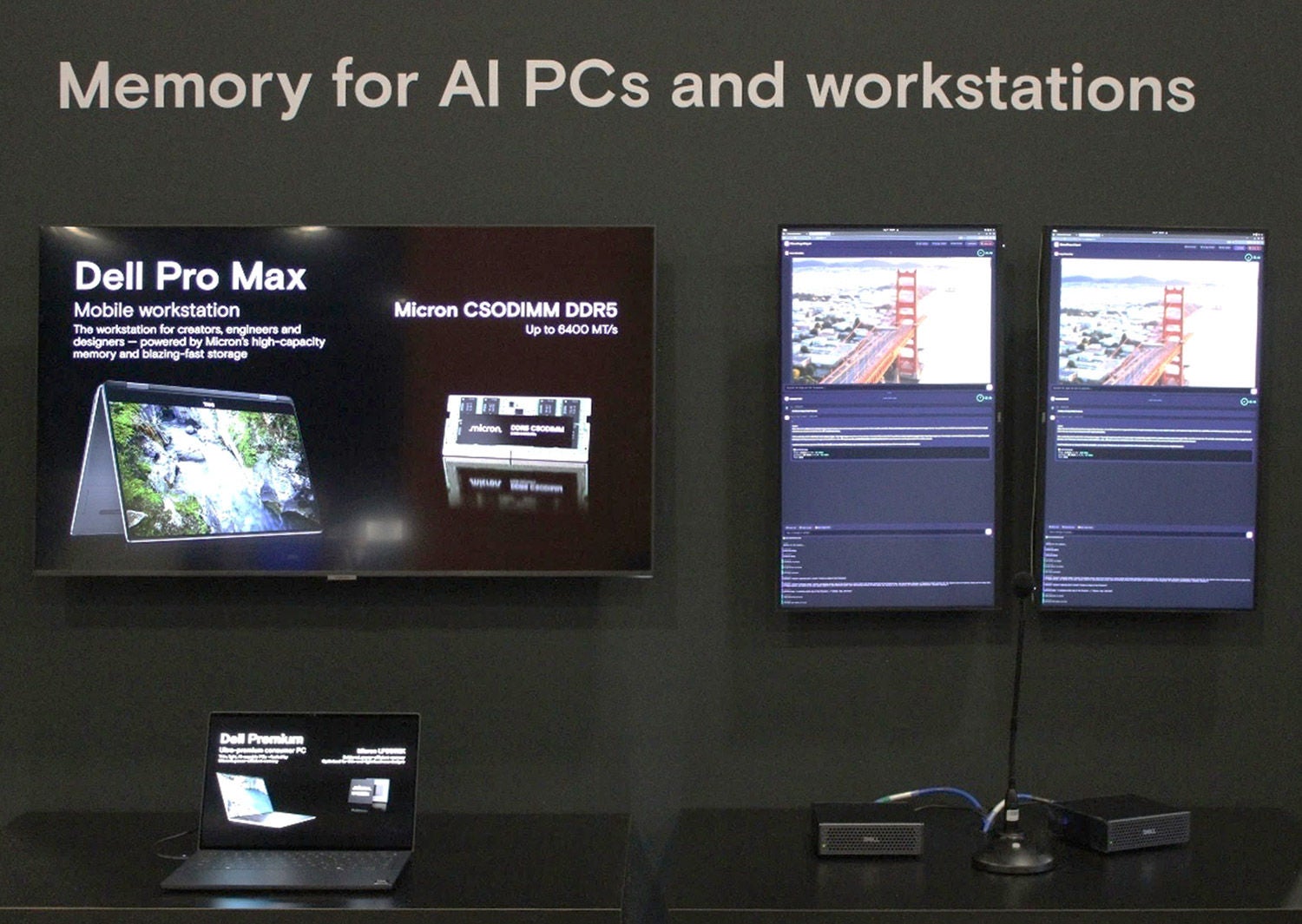
Figure 1: Micron's "Memory for AI PCs and workstations" demo at Dell Technologies World, Las Vegas, May 2026. Side-by-side Dell Pro Max systems running concurrent agentic AI workloads, powered by Micron’s LPDDR5X
A real world agentic workflow under sustained memory pressure
In the demo, two identical Dell Pro Max systems ran the same agentic workflow: A user speaks into a microphone, a speech to text algorithm transcribes the user’s input locally and a large language model (LLM) generates an image prompt. The system then runs Stable Diffusion 3.5 Large Turbo for image generation alongside a Qwen3.5 35B A3B reasoning model concurrently across the GPU and CPU, creating real, sustained memory demand that reflects how next generation AI workloads actually behave.
Why capacity, not compute, determines workflow fluidity
The only difference between the two systems was capacity — 64GB versus 128GB of LPDDR5X — but that difference becomes critical when running AI workloads locally instead of relying on the data center. The 128GB system completes the workflow roughly 30% faster, with smoother execution and fewer stalls, reducing the need to offload tasks back to the cloud. With less memory, the CPU shuffles data more often and the GPU waits; with more memory, everything stays local and just flows.
128GB is no longer excess — it’s headroom
At first glance, 128GB may seem like a lot of memory for a desktop-class system — but in the context of agentic AI, it's quickly becoming the new baseline. A single modern reasoning model can consume 25–30GB on its own, an image diffusion model can consume another 20+ GB and supporting components like speech recognition, embedding models and growing context windows continue to add up. Because UMA shares one pool of memory across CPU, GPU and the operating system, every active component draws from the same budget. As agents become more capable — handling longer conversations, larger context windows and more concurrent tasks—memory needs will only grow. 128GB isn't excess; it's headroom for what's coming next. Investing in capacity today means a workstation that stays fluid and capable as agentic AI matures.
Memory capacity as a first order design decision
As AI workstations evolve from bursty inference machines into platforms for long lived, agentic workflows, memory capacity becomes a first order design decision. Systems that are sized for yesterday’s workloads will quietly introduce friction tomorrow — slower iteration, stalled pipelines and diminished user experience.
Designing AI workstations for what comes next
The opportunity now is to design AI workstations with sufficient memory headroom from the start. By pairing leading compute platforms with high capacity, high bandwidth Micron memory, OEMs and enterprises can ensure their AI systems remain fluid, responsive and ready for the next generation of agentic AI, locally, securely and at scale.
See how memory capacity impacts real AI performance on the mobile and client ecosystems — and why keeping workloads local matters. Dive deeper here.